
Menu
Table of Contents
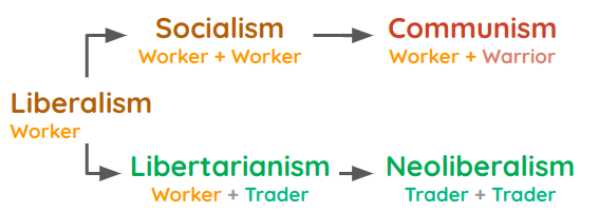
Negative Liberalism of the Worker class when combined with the Negative Warrior Mentality leads to Communism.
Communism began as a moral and intellectual response by Karl Marx to the extreme inequality and suffering brought by the Industrial Revolution.
His desire was to lift the working class out of poverty. Unfortunately, his ideas were based on materialism which was also the basis of the capitalism that caused the injustice during the Industrial Revolution.
- Capitalism is Negative Trader because Materialism is Negative
- Communism is Negative Worker as it is also based on Materialism
In The Communist Manifesto (1848) and Das Kapital (1867), he argued that history was driven by class struggle: between those who owned property and those who only had their labor to sell.
Marx created communism out of a desire to end exploitation, not to seize power or control people.
The Demands of Communism
Karl Marx and Frederick Engels listed the 10 demands of Communism in The Communist Manifesto:
- Abolition of [capitalist] property in land and application of all rents of land to public purposes.
- A heavy progressive or graduated income tax.
- Abolition of all rights of inheritance.
- Confiscation of the property of all emigrants and rebels.
- Centralisation of credit in the hands of the state, by means of a national bank with State capital and an exclusive monopoly.
- Centralisation of the means of communication and transport in the hands of the State.
- Extension of factories and instruments of production owned by the State
- The cultivation of waste-lands
- The improvement of the soil generally in accordance with a common plan.
- Equal liability of all to work.
- Establishment of industrial armies, especially for agriculture.
- Combination of agriculture with manufacturing industries
- Gradual abolition of all the distinction between town and country by a more equable distribution of the populace over the country.
- Free education for all children in public schools.
- Abolition of children’s factory labour in its present form.
- Combination of education with industrial production, etc.
Marx and Engels believed that such policies would concentrate production into the hands of the State.
This would then make:
- the public power will lose its political character
- class distinctions disappear
Class distinctions would be replaced by association. This is a development of Rousseaus’s liberalism.
Our law of social cycles says that humans, by the design of Nature, fall under 4 large classes:
- Workers
- Warriors
- Thinkers
- Traders
Removing such distinctions would therefore be going against Nature. This is why Communist systems imploded naturally by themselves.
Lenin
In 1917, Vladimir Lenin led the Russian Revolution, establishing the world’s first communist state in a largely agricultural, not industrial, country.
To organize the transition, the government took centralized control of the economy and politics. Over time, this led to one-party rule, state planning, and restrictions on personal freedoms—developments Marx never described or intended.
Later regimes in China, Cuba, and elsewhere followed similar structures. While many promised equality and welfare, in practice they often suffered from inefficiency, lack of choice, and human rights abuses.
This created a wide gap between Marx’s original ideal and the systems that bore his name.
Both Communism and Capitalism Enslave Humans
Communism lets the state enslave man, whereas Capitalism lets the capital owners do it
Thus, in modern capitalism (Mill’s capitalism), workers are actually slaves in essence, different from the capitalism of Turgot, Say, and Ricardo.
All of the work done by an employee in a modern company belongs to that company’s owners in exchange for a fixed wage. This is different from the original capitalism where the workers were paid by the piece or had profit sharing in co-partneries.
It was Mill who corrupted the word ‘capitalist’, equating it more to ‘owner of someone else’s work’ instead of the proper classical definition of ‘someone who lives by profits’ as used by Smith and the Physiocrats.
Thus, Capitalism is from Mill and not Smith.
Smith’s economic system gave importance to all three classes of rent-earners, wage-earners, and profit-earners. But Mill only gave importance to the profit earners.
This absurdity became fuel for Marx to attack Mill:
Men who claimed some scientific standing tried to harmonise the Political Economy of capital with the claims..of the proletariat. Hence a shallow syncretism of which John Stuart Mill is the best representative. Under these circumstances its professors fell into two groups:
- the prudent, practical business folk flocked to Bastiat
- the other.. followed John Stuart Mill in his attempt to reconcile irreconcilables.*
*Note that ‘reconciling irreconcilables’ was also more recently done by Paul Samuelson in his ’neo-classical synthesis’
Marx’ main description of capitalism as a system where resources are amassed through centralization for private gain is consistent with our definition of a system of pooling resources together through equity:
Capital grows in one place to a huge mass in a single hand, because it has in another place been lost by many. This is centralisation proper, as distinct from accumulation [which is] very slow compared to centralisation.. The world would still be without railroads, if it had to wait for accumulation..Centralisation, on the other hand, accomplished this by a turn of the hand through stock companies.
Nowadays, almost anyone can own stocks and some people, like pensioners and insurance buyers, don’t even know that they are indirectly owning stocks, and are getting a steady revenue from the work of others without working themselves.
More obviously, the most common buzz in today’s business news are stock prices, proving the importance of equity to capitalism. Turn on CNBC and Bloomberg and you will see stock information everywhere.
If the world had stayed in mercantilism, then commodity prices would be shown instead.
Leave a Comment
Thank you for your comment!
It will appear after review.