
Menu
Table of Contents
Socialism started gaining ground in the 19th century through the inequality that went with the rise of wealth of Europe from the Mercantile system.
This led to moral decline.
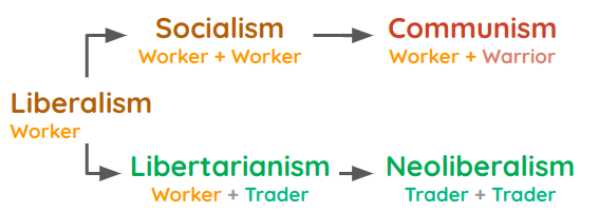
We can say that Socialism (worker-worker philosophy) is the natural effect of Liberalism (worker philosophy) just as Liberalism is the natural effect of Mercantilism (trader philosophy).
The French economists Henri de Saint-Simon pushed this as an alternative to the unregulated freedom after the French Revolution had destroyed the controlling power of the monarchy and the church.
Socialism advocates for collective or governmental control over the means of production to ensure wealth and resources are distributed more equally.
It emphasizes:
- social welfare
- economic equality
- workers’ rights
- state or collective ownership of major industries
- progressive taxation
- wealth redistribution to reduce inequality
Examples are The Soviet Union, Cuba, and modern social democracies (e.g., Sweden).
Democratic Socialism
Unlike Socialism which has strong central control, democratic socialism combines emphasizes the democratic political system.
It advocates for the public ownership of essential industries and services (e.g., healthcare, education) while allowing private ownership in other sectors.
It has High taxation, wealth redistribution, universal public services, and workers’ rights protection.
Examples are the Modern Scandinavian countries (e.g., Denmark, Norway), as well as the UK under Labour governments.
Leave a Comment
Thank you for your comment!
It will appear after review.