Menu
The First Law of Value states:
Exchangeable value is based on relational desire.

This law is derived from:
- the Worker cycle in the Law of Social Cycles by Socrates
- the Third Law of Thermodynamics which says that absolute zero temperature is impossible to reach or maintain. In Supereconomics, this means that desire is never zero
This law crosses over:
- to Bio Superphysics as everything being able to affect a person’s health in varying degrees.
- to Supersociology as everyone’s opinion or expression has a value to a society
In Supereconomics, this manifests as Nominal Price which is an effect of Effective Demand.
Relationality
Since desire manifests as demand, everyone has both an effective or actual demand, and an absolute or wishful desire.
- Effective demand operates in the physical domain as the lower part of the human oversoul
- Absolute demand operates in the metaphysical domain as the upper part
The modern economic system bases exchangeable value in the physical things from the body’s perspective in the Crude layer, instead of from that of the oversoul or the society-organism in the Essential layer.
Relationality imposes the natural connection of ideas and entities via their gravitational signature. This is most obviously seen in physical gravity and magnetism.
In social life, this is seen in buyers gravitating towards sellers that match their needs, tastes, budgets, personality, location, etc based on the engine of natural economic desire.
- However, this desire can be corrupted by external influence from society, education, culture, disasters, etc.
The first law imposes this relationality to correct the corruptions of economic desire by establishing a floor or solid foundation which is based on fellow feeling or common interest.
The result is the nominal price which manifests as a range.
Formula
(N = DAt : DBt : DCt • σ (Di - Dm)
- N : Nominal Price Range
- DAt : Effective Demand of Person A at time t
- DBt : Effective Demand of Person B at time t
- DCt : Effective Demand of Person C at time t
- Di : Effective Demand of an individual in the chain
- Dm : The minimum societally-acceptable demand
- σ : step function where the output is 1 (valid) if Di ≥ Dm, and 0 (invalid/null) if Di < Dm
The ratio sign represents relationality. This creates an economic relational chain.
The gravitational signature or metaphysical spin is within Di that is applied onto the chain that includes people in the society.
- A bigger society will have more diverse spins
This means that the resulting nominal value is a result of interaction of spins which represents the causal feeling behind the valuation.
Example
For example, a person might want ice cream because he feels the desire of experiencing cold sweetness, as opposed to the hot bitterness of coffee.
This can be extended to include C, D, E, and so on, to show:
- the relational value perceptions towards ice cream and coffee
- the interconnected nature of any economy, wherein a change in one actual valuation causes a change in the rest.
In deconstructed Supermath notation:
nominal_price_range icecream = person_A_demandicecream_now : person_B_demandicecream_now : person_C_demandicecream_now : person_D_demandicecream_now
nominal_price_range coffee = person_A_demandcoffee_now : person_B_demandcoffee_now : person_C_demandcoffee_now : person_D_demandcoffee_now
This creates a relation between the demand for ice cream and coffee.
nominal_price_range ice cream : nominal_price_range coffee
The time factor makes the chain dynamic. When added to the relationality, it exposes the liquid dynamics of desire within a plenum, consistent with the wave-nature of Existence.
The time snapshot, as now, represents the spacetime slice where the effective demand, and consequently, the nominal value perceptions occur.
This leads to:
- individual or personal nominal prices
- societal nominal prices as a range

Minimum Needs in σ and Gross National Happiness
The unity of the society-organism is expressed in:
- the Gross National Happiness (GNH) framework as the static part of Supereconomics
- the Supereconomic model of progress (SMOP) as the dynamic part
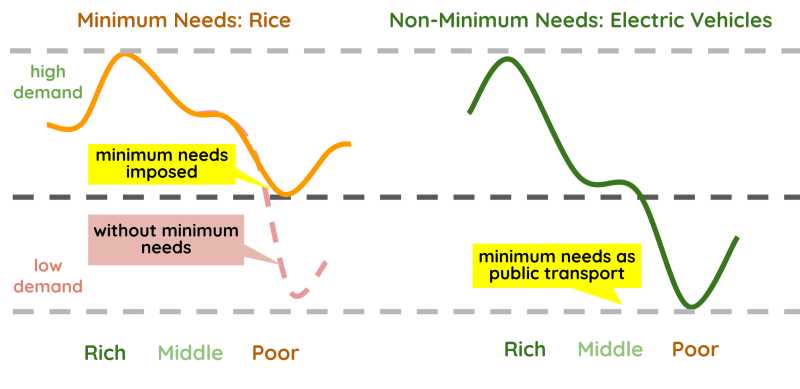
Minimum needs is a fundamental and foundational part of both GNH and SMOP as part of relationality. These prevent the violations of the 1st Law of Value as:
- Underdemand
- Overedemand
Minimum needs manifests as Dm which is checked against individual demand Di and applied onto the chain by σ.
Leave a Comment
Thank you for your comment!
It will appear after review.