
Menu
Table of Contents
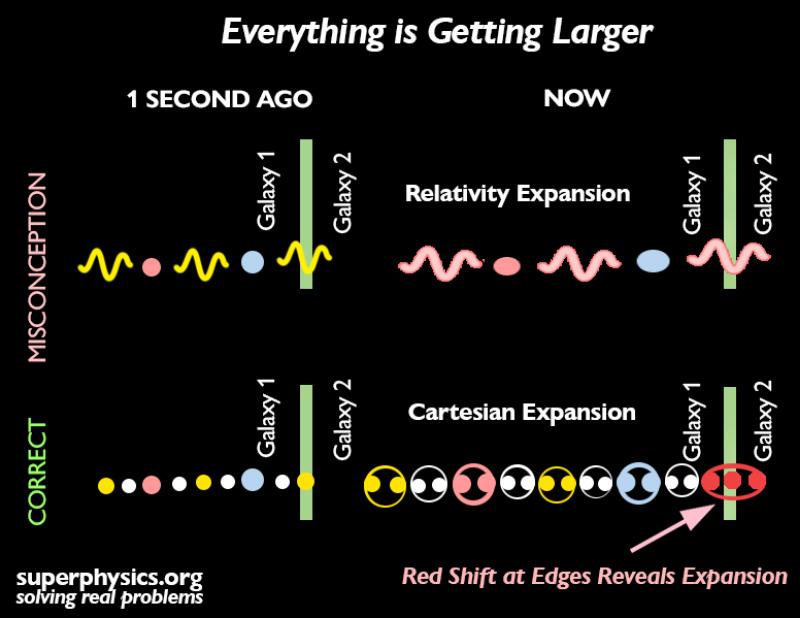
The Expansion of Space
Material Superphysics explains the large scale phenomena of the universe through the 2 sublayers of the Spatial Layer:
- Aether
Unlike the Minkowski spacetime of Physics which has 4 dimensions in a continuum of time, the spacetime of Material Superphysics takes the form of 2-dimensional slices that are separated by the macro-aetherspace.
- Macro-Aetherspace
This is known to Physics as the Planck Length and Planck Time.
While Dark Matter is facilitated by spacetime, Dark Energy is facilitated by the macro-aetherspace.
Waves Within Waves
The aether waves ride the macro-aetherspace wave which separate each reality.
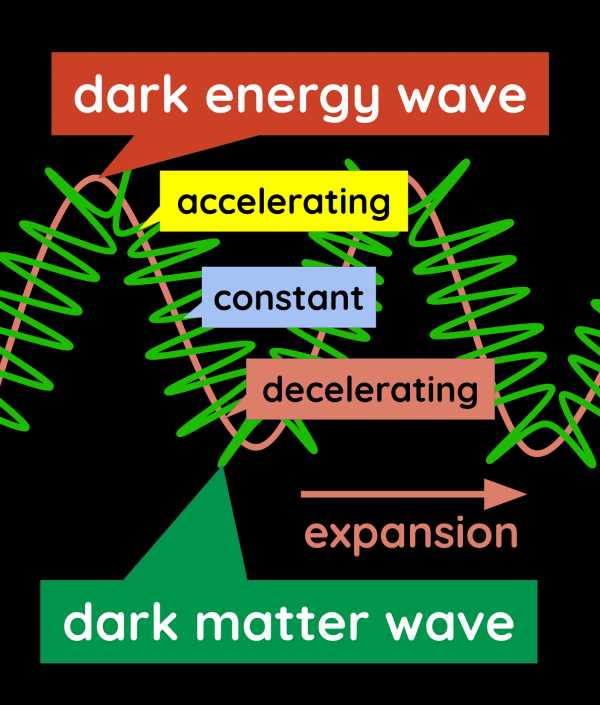
The macro-aetherspace wave moves forward, creating the apparent expansion of the universe.
This stretches the dark matter waves that ride it.
The expansion:
- accelerates after the dark matter wave leaves the pauses
- remains constant
- decelerates before hitting another pause
Dependent on the Observer
The expansion of the universe is dependent on the aethereal mind that observes that universe, being of the same substance as the mechanism of expansion.
- In the prehistoric period, cavemen looked at the stars and saw no expansion
- In the age of telescopes, humans looked at the stars and saw expansion.
- In the age of space telescopes, humans looked at the stars and saw accelerated expansion.
This matches the expansion of the human mind.
- In the prehistoric period, the human mind was not expanded
- In the age of telescopes, it started expanding
- In the age of space telescopes, it started expanding faster
The matter which already fills space G cannot successively fill all the spaces between G and E which are infinitely smaller. Some part of that matter must adapt its shape to the countless measures of those spaces.
To achieve this, all its innumerable particles must be separated from each other by division. This leads to the division of certain particles of matter into infinity, or indefinitely.

The abstract mind expands by “dividing” and analyzing its perceptions. This action (see Chapter 6b) is done through the aetherspace which it imposes onto spacetime.
This is because the aetherspace is ‘alive’ whereas spacetime is ‘dead’.
The dead force, or simple gravitation in a body at rest, produces no observable change and hence no effect. But impact does. Therefore, since forces are proportional to their effects, then dead force is null.

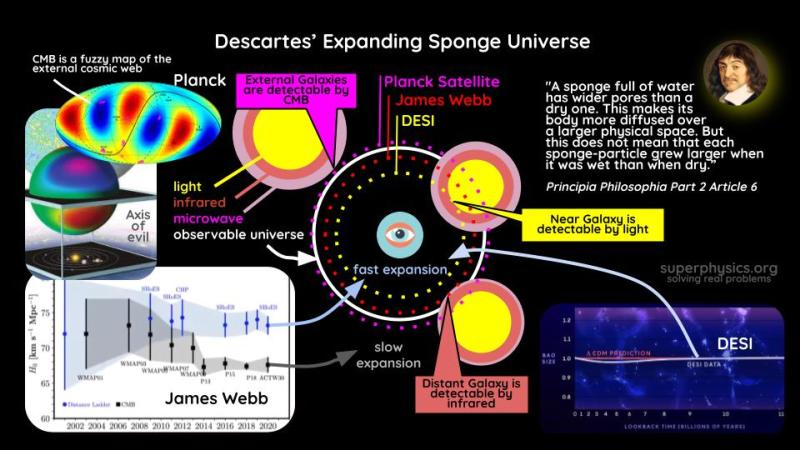
The Proper Way to Interpret and Use General Dark Matter Knowledge
Since dark matter totally depends on observer, its general practical use, outside of anti-gravity and chemistry, is to gauge the current wave-status of society.
- This is where Material Superphysics connects to Social Superphysics via dark energy through the pure aether which is the layer above it.
Researchers could make a survey on whether people think that dark energy is:
- speeding up
- constant
- slowing down
This would then expose what part of the wave (of the society organism) the human species is currently in.
We assume that the wave is in the slowing speed as part of the transition to 4th density.
A wave in the accelerating part would mean that humans are new to 3rd density or are just entering the higher aspects of 3rd density.
Leave a Comment
Thank you for your comment!
It will appear after review.