Table of Contents
| Current Cycle | Years per Day | Current Week | Current Month | Current Year |
|---|---|---|---|---|
| ? | ? | ? | ? | ? |
Why Abenomics and Keynesian Economics Failed
Japan has been suffering from chronic deflation since 1991 after the bursting of their asset price bubble.
This is caused by the Bretton Woods system and the defeat of Japan during World War 2.
Japan has recently tried to solve this through Abenomics.
What is Abenomics?
Abenomics is a set of economic policies organized into 3 arrows:
1. Aggressive Monetary Policy
This pumps money into the private sector (microeconomy) so that businesses will employ people. This does not always work since microeconomics only uses labor if there is something profitable to employ that labor on.
An advanced economy will have so much competition and so many products. These reduce margins and discourage further investment.
As such, this situation merely keeps the money stuck in money markets and even makes it go overseas.
An easy proof is the Vision Fund of Softbank which invests in non-Japanese companies like WeWork and Uber, and the huge overseas investments by Japanese banks before and after the pandemic
In a country fully peopled.. the competition for employment would necessarily be so great as to reduce the wages of labour.. In a country fully stocked in proportion to all the business it had to transact.. the competition.. would everywhere be as great, and consequently the ordinary profit as low as possible

2. Fiscal Stimulus
The profit maximization doctrine of microeconomics prevents businesses from hiring people even when money is available (since that money might not return with profits).
The economist John Maynard Keynes patched this problem by letting the government do the hiring. This creates a “multiplier effect” from the public sector which is similar to, but smaller than, a multiplier effect from the private sector.
The government can do this because it can charge taxes to get back the value that it spent.
However, this method:
- raises public debt
- increases the risk of credit downgrade
- transfers the present burden to future generations who will be born with so many taxes to pay.
These will manifest as inflated prices and deflated real wages which prevent them from enjoying the life that the previous generation had.
For example, the previous generation never had to deal with supertyphoons, pandemics, and the permanently hot weather that they unknowingly created for the current generation. Rather, they knew about it but just didn’t care.
The ruinous practice of perpetual funding puts off the liberation of the public revenue from a fixed period to an indefinite period, never likely to come. However, it raises more money than the old practice of anticipation. When men became familiar with funding, it became universally preferred to anticipation during great state exigencies. Relieving the present exigency is always the object of government. The future liberation of the public revenue they leave to the care of posterity.
3. Structural Reforms
To support the 2 arrows, the Japanese government had planned additional policies such as:
- signing new trade deals
- raising taxes
- encouraging women in labour
- improving corporate governance and medical care
- allowing more foreign immigrants
However, these were not given as much focus as the first two arrows, leading to their incomplete implementation and subsequent failure.
The failure of structural reforms is a sign that the influence of corporate Japan is still very strong.
Using social cycle theory, we can make analogies between ancient and modern Japan:
- Japan Inc and employers are the modern daimyos
- The Prime Minister is a modern shogun who must work with his daimyos
- Japanese employees are modern samurais who must work overtime for their daimyos and pay sales taxes to the shogun. Karoshi (death by overwork) is a modern variant of seppuku (ritual suicide), with the sense of honor operating from the back of their minds in both cases. This is not the case in most other countries.
Sir Robert Walpole tried to establish an excise scheme on wine and tobacco similar to my proposal. The bill with those two commodities was then brought into Parliament. It was supposed to be an introduction of a more extensive scheme of the same kind. Faction and smuggling merchants raised a violent and unjust clamour against that bill. The minister dropped it. None of his successors dared to resume the project from fear of exciting another clamour.
The Problem with Keynes
The dominance of the daimyos over the shogun leads to a solution that does not work on the problem, but rather helps the daimyos.
Politically, Japan needs a modern Tokugawa Iyeyasu to make structural reform a priority. Without such reform, Japan’s stagnation will only continue.
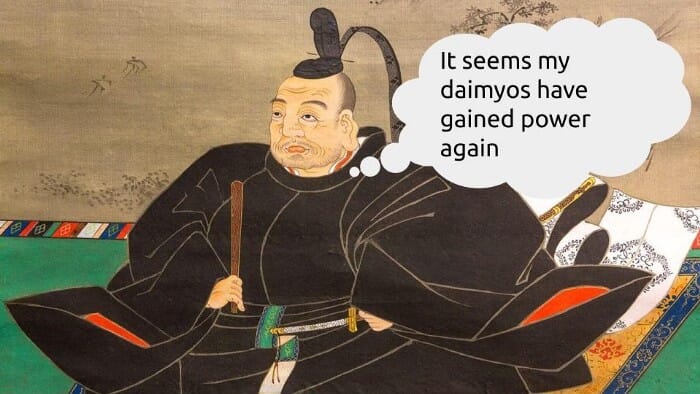
After a modern Tokugawa quells his daimyos*, the question then becomes: what policies should be implemented?
Superphysics Note!
From the failure of Abenomics, it is obvious that the policy should not be Keynesian. From the prioritization of the arrows, you can see the dominance of money in making up the first 2 goals. The dominance of money is also present in Keynes’ General Theory.
In fact, the 3 arrows of Abenomics looks as though someone copy-pasted Keynes onto an economic policy plan:
- Arrow 1 is Book 4: The Inducement to Invest. This has the liquidity-preference and monetary expansion
- Arrow 2 is Book 3: The Propensity to Consume. This has government spending and the multiplier effect
- Arrow 3 is Book 5: Money-Wages and Prices. This has wage increase and structural reform
A Depression is not a Deflation
The problem is that Keynes’ work was tailored for a depression, but Japan’s problem is twofold:
- The growth barriers created by Bretton Woods
- A deflation from its declining population
The Growth Barrier
After Japan lost WWII, the US became a superpower imposing the US dollar as a global currency.
This is opporessive to countries that has less productivity than the US, but oppressive to the US when trading with countries with more productivity than the US.
Japan, Korea, and China have more productivity than the US which causes a trade deficit in the US.
To fix this, the US forced Japan to strengthen the Yen in 1985. This deflated Japan to prop up the US.
China, on the other hand, could not be coerced by the US to strengthen its Yuan and so the US launched a trade war to prop up the US. This has stifled China’s economy just as the asset price bubble of Japan stifled that of Japan.
Deflation
The growth barrier discourages the natural growth of an economy. This leads to inflation and stress that makes raising a family harder. This leads to a population decline that results in a deflation. The same thing is happening in China and Korea.
The monetary policies of Japan do not strike at the root of the problem. It’s like taking cough syrup to treat back pain.
The Solution/s
Instead of 3 arrows, Abenomics really only needed 2 arrows of mega-structural reform to deal with the 2 problems which is really rooted in the defeat of Japan in WWII.
- Increase Population and Dynamism: East Asia Union
The first solution is a Free Trade Zone between Japan, South Korea, China, and Taiwan with East Asia free trade zone or union with free immigration.
An East Asia union would solve:
- Japan’s deflation
- China’s tech sector problem (or Taiwan’s security issues)
- South Korea’s grievances against Japan
This goes without saying that the cultural differences and historical problems between the countries should be resolved beforehand.
- Multilateral Clearing within the East Asia Union
Instead of a single currency like the Euro, the East Asia Union would use a multilateral clearing system that is derived form EF Schumacher’s alternative to the Bretton Woods system.
This frees up the productive countries to grow without being stifled by trade wars or forced currency strengthening.
Leave a Comment
Thank you for your comment!
It will appear after review.