Table of Contents
“Faith in God can produce any miracle except one — passing an examination without study.”
Distastefully I closed the book I had picked up in an idle moment.

My promise to Father had been that I would complete my high school studies. I cannot pretend to diligence. The passing months found me less frequently in the classroom than in secluded spots along the Calcutta bathing ghats.
The adjoining crematory grounds, especially gruesome at night, are considered highly attractive by the yogi. He who would find the Deathless Essence must not be dismayed by a few unadorned skulls. Human inadequacy becomes clear in the gloomy abode of miscellaneous bones. My midnight vigils were thus of a different nature from the scholar’s.
The week of final examinations at the Hindu High School was fast approaching. This interrogatory period, like the sepulchral haunts, inspires a well-known terror. My mind was nevertheless at peace. Braving the ghouls, I was exhuming a knowledge not found in lecture halls.
But it lacked the art of Swami Pranabananda, who easily appeared in two places at one time. My educational dilemma was plainly a matter for the Infinite Ingenuity. This was my reasoning, though to many it seems illogic. The devotee’s irrationality springs from a thousand inexplicable demonstrations of God’s instancy in trouble.

A classmate accosted me one afternoon on Gurpar Road.
I unburdened myself under his friendly gaze. Nantu, who was a brilliant student, laughed heartily; my predicament was not without a comic aspect.
The simple words conveyed divine promise to my ears; with alacrity I visited my friend’s home. He kindly outlined the solutions to various problems he considered likely to be set by the instructors.
The night was far gone when I departed. Bursting with unseasoned erudition, I devoutly prayed it would remain for the next few critical days. Nantu had coached me in my various subjects but, under press of time, had forgotten my course in Sanskrit. Fervently I reminded God of the oversight.
I set out on a short walk the next morning, assimilating my new knowledge to the rhythm of swinging footsteps. As I took a short cut through the weeds of a corner lot, my eye fell on a few loose printed sheets. A triumphant pounce proved them to be Sanskrit verse. I sought out a pundit for aid in my stumbling interpretation. His rich voice filled the air with the edgeless, honeyed beauty of the ancient tongue.

The scholar dismissed them skeptically. But familiarity with that particular poem enabled me on the following day to pass the Sanskrit examination. Through the discerning help Nantu had given, I also attained the minimum grade for success in all my other subjects.
Father was pleased that I had kept my word and concluded my secondary school course. My gratitude sped to the Lord, whose sole guidance I perceived in my visit to Nantu and my walk by the unhabitual route of the debris-filled lot. Playfully He had given a dual expression to His timely design for my rescue.
I came across the discarded book whose author had denied God precedence in the examination halls. I could not restrain a chuckle at my own silent comment:
In my new dignity, I was now openly planning to leave home. Together with a young friend, Jitendra Mazumdar, I decided to join a Mahamandal hermitage in Benares, and receive its spiritual discipline.
A desolation fell over me one morning at thought of separation from my family. Since Mother’s death, my affection had grown especially tender for my two younger brothers, Sananda and Bishnu. I rushed to my retreat, the little attic which had witnessed so many scenes in my turbulent sadhana. After a two-hour flood of tears, I felt singularly transformed, as by some alchemical cleanser. All attachment disappeared; my resolution to seek God as the Friend of friends set like granite within me. I quickly completed my travel preparations.

Father was distressed as I stood before him for final blessing.
With reluctant parental consent, I set out to join Jitendra, already in Benares at the hermitage. On my arrival the young head swami, Dyananda, greeted me cordially. Tall and thin, of thoughtful mien, he impressed me favorably. His fair face had a Buddhalike composure.
I was pleased that my new home possessed an attic, where I managed to spend the dawn and morning hours. The ashram members, knowing little of meditation practices, thought I should employ my whole time in organizational duties. They gave me praise for my afternoon work in their office.

This ridicule from a fellow resident accompanied one of my early departures toward the attic. I went to Dyananda, busy in his small sanctum overlooking the Ganges.
The orange-robed ecclesiastic gave me an affectionate pat. Staging a mock rebuke, he admonished a few near-by disciples.

I politely concealed my doubt. The students left the room, not overly bent with their chastisement. Dyananda had further words for me.
Whether famishment gleamed in my eye, I knew not. That I was hungry, I knew only too well. The invariable hour for the first hermitage meal was twelve noon. I had been accustomed in my own home to a large breakfast at nine o’clock.
The three-hour gap became daily more interminable. Gone were the Calcutta years when I could rebuke the cook for a ten-minute delay. Now I tried to control my appetite; one day I undertook a twenty-four hour fast. With double zest I awaited the following midday.

Jitendra brought me this devastating news. As gesture of welcome to the swami, who had been absent for two weeks, many delicacies were in readiness. An appetizing aroma filled the air. Nothing else offering, what else could be swallowed except pride over yesterday’s achievement of a fast?
The Heavenly Provider, I thought, was hardly included in the interdiction with which Dyananda had silenced me. Divine Attention was elsewhere, however; the plodding clock covered the hours. Darkness was descending as our leader entered the door. My greeting was one of unfeigned joy.
Jitendra approached me again as a bird of ill omen. I was in near-collapse. My young stomach, new to deprivation, protested with gnawing vigor. Pictures I had seen of famine victims passed wraithlike before me.
Impending doom averted at nine o’clock. Ambrosial summons! In memory that meal is vivid as one of life’s perfect hours.
Intense absorption yet permitted me to observe that Dyananda ate absent-mindedly. He was apparently above my gross pleasures.
Happily surfeited, I was alone with the leader in his study.
O yes! I have spent the last four days without food or drink. I never eat on trains, filled with the heterogenous vibrations of worldly people. Strictly I observe the shastric rules for monks of my particular order.
Certain problems of our organizational work lie on my mind. Tonight at home I neglected my dinner. What’s the hurry? Tomorrow I’ll make it a point to have a proper meal.
He laughed merrily. Shame spread within me like a suffocation. But the past day of my torture was not easily forgotten; I ventured a further remark.
I found his incisive words entering some deep marrow. Gone was an age-old delusion by which bodily imperatives outwit the soul. There and then I tasted the Spirit’s all-sufficiency. In how many strange cities, in my later life of ceaseless travel, did occasion arise to prove the serviceability of this lesson in a Benares hermitage!
The sole treasure which had accompanied me from Calcutta was the sadhu’s silver amulet bequeathed to me by Mother. Guarding it for years, I now had it carefully hidden in my ashram room. To renew my joy in the talismanic testimony, one morning I opened the locked box. The sealed covering untouched, lo! the amulet was gone. Mournfully I tore open its envelope and made unmistakably sure. It had vanished, in accordance with the sadhu’s prediction, into the ether whence he had summoned it.
My relationship with Dyananda’s followers grew steadily worse. The household was alienated, hurt by my determined aloofness. My strict adherence to meditation on the very Ideal for which I had left home and all worldly ambitions called forth shallow criticism on all sides.
Torn by spiritual anguish, I entered the attic one dawn, resolved to pray until answer was vouchsafed.
The passing hours found my sobbing pleas without response. Suddenly I felt lifted as though bodily to a sphere uncircumscribed.

A divine womanly voice came from everywhere and nowhere. This supernal experience was pierced by a shout from a definite locale. A young priest nicknamed Habu was calling me from the downstairs kitchen.

Another day I might have replied impatiently; now I wiped my tear-swollen face and meekly obeyed the summons. Together Habu and I set out for a distant market place in the Bengali section of Benares. The ungentle Indian sun was not yet at zenith as we made our purchases in the bazaars. We pushed our way through the colorful medley of housewives, guides, priests, simply-clad widows, dignified Brahmins, and the ubiquitous holy bulls. Passing an inconspicuous lane, I turned my head and surveyed the narrow length.
A Christlike man in the ocher robes of a swami stood motionless at the end of the road. Instantly and anciently familiar he seemed; my gaze fed hungrily for a trice. Then doubt assailed me.

After ten minutes, I felt heavy numbness in my feet. As though turned to stone, they were unable to carry me farther. Laboriously I turned around; my feet regained normalcy. I faced the opposite direction; again the curious weight oppressed me.
With this thought, I heaped my parcels into the arms of Habu. He had been observing my erratic footwork with amazement, and now burst into laughter.
My tumultuous emotion prevented any retort; I sped silently away. Retracing my steps as though wing-shod, I reached the narrow lane. My quick glance revealed the quiet figure, steadily gazing in my direction. A few eager steps and I was at his feet.
The divine face was none other than he of my thousand visions. These halcyon eyes, in leonine head with pointed beard and flowing locks, had oft peered through gloom of my nocturnal reveries, holding a promise I had not fully understood.
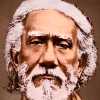
My guru uttered the words again and again in Bengali, his voice tremulous with joy. We entered a oneness of silence; words seemed the rankest superfluities. Eloquence flowed in soundless chant from heart of master to disciple. With an antenna of irrefragable insight I sensed that my guru knew God, and would lead me to Him. The obscuration of this life disappeared in a fragile dawn of prenatal memories. Dramatic time! Past, present, and future are its cycling scenes. This was not the first sun to find me at these holy feet!
My hand in his, my guru led me to his temporary residence in the Rana Mahal section of the city. His athletic figure moved with firm tread. Tall, erect, about fifty-five at this time, he was active and vigorous as a young man. His dark eyes were large, beautiful with plumbless wisdom. Slightly curly hair softened a face of striking power. Strength mingled subtly with gentleness.
As we made our way to the stone balcony of a house overlooking the Ganges, he said affectionately:
The swift Indian twilight had dropped its half-curtain before my master spoke again. His eyes held unfathomable tenderness.
Precious words! A quarter-century elapsed before I had another auricular proof of his love. His lips were strange to ardor; silence became his oceanic heart.
He gazed at me with childlike trust.
He rose then in the gathering darkness and guided me to an inner room. As we ate mangoes and almond sweetmeats, he unobtrusively wove into his conversation an intimate knowledge of my nature. I was awe-struck at the grandeur of his wisdom, exquisitely blended with an innate humility.
Like a divine mirror, my guru apparently had caught a reflection of my whole life.
His suggestion dismayed me. My family was predicting my return, though I had been unresponsive to many pleas by letter. “Let the young bird fly in the metaphysical skies,” Ananta had remarked. “His wings will tire in the heavy atmosphere. We shall yet see him swoop toward home, fold his pinions, and humbly rest in our family nest.” This discouraging simile fresh in my mind, I was determined to do no “swooping” in the direction of Calcutta.
I wondered at God’s intricate play with His devotees. Serampore is but twelve miles from Calcutta, yet in those regions I had never caught a glimpse of my guru. We had to travel for our meeting to the ancient city of Kasi (Benares), hallowed by memories of Lahiri Mahasaya. Here too the feet of Buddha, Shankaracharya and other Yogi-Christs had blessed the soil.
I remained obstinately silent. My guru easily penetrated my difficulty.
Bowing reverently at his feet, I departed without lightening the controversial tension. As I made my way in the midnight darkness, I wondered why the miraculous meeting had ended on an inharmonious note. The dual scales of maya, that balance every joy with a grief! My young heart was not yet malleable to the transforming fingers of my guru.
The next morning I noticed increased hostility in the attitude of the hermitage members. My days became spiked with invariable rudeness. In three weeks, Dyananda left the ashram to attend a conference in Bombay; pandemonium broke over my hapless head.

Overhearing this remark, I regretted for the first time that I had obeyed the request to send back my money to Father. With heavy heart, I sought out my sole friend, Jitendra.
Jitendra spoke with determination.
And so the “bird” prepared to “swoop” perilously close to Calcutta!
Footnotes
10-1: Sanskrita, polished; complete. Sanskrit is the eldest sister of all Indo-European tongues. Its alphabetical script is Devanagari, literally “divine abode.” “Who knows my grammar knows God!” Panini, great philologist of ancient India, paid this tribute to the mathematical and psychological perfection in Sanskrit. He who would track language to its lair must indeed end as omniscient.
10-2: He was not Jatinda (Jotin Ghosh), who will be remembered for his timely aversion to tigers!
10-3: Path or preliminary road to God.
10-4: Hindu scriptures teach that family attachment is delusive if it prevents the devotee from seeking the Giver of all boons, including the one of loving relatives, not to mention life itself. Jesus similarly taught: “Who is my mother? and who are my brethren?” (Matthew 12:48.)
10-5: Ji is a customary respectful suffix, particularly used in direct address; thus “swamiji,” “guruji,” “Sri Yukteswarji,” “paramhansaji.”
10-6: Pertaining to the shastras, literally, “sacred books,” comprising four classes of scripture: the shruti, smriti, purana, and tantra. These comprehensive treatises cover every aspect of religious and social life, and the fields of law, medicine, architecture, art, etc. The shrutis are the “directly heard” or “revealed” scriptures, the Vedas. The smritis or “remembered” lore was finally written down in a remote past as the world’s longest epic poems, the Mahabharata and the Ramayana. Puranas are literally “ancient” allegories; tantras literally mean “rites” or “rituals”; these treatises convey profound truths under a veil of detailed symbolism.
10-7: “Divine teacher,” the customary Sanskrit term for one’s spiritual preceptor. I have rendered it in English as simply “Master.”
Leave a Comment
Thank you for your comment!
It will appear after review.