Table of Contents
The Colossi of Memnon 2 huge statues standing at the entrance to Amenhotep 3rd’s mortuary temple at Kom el-Hetan
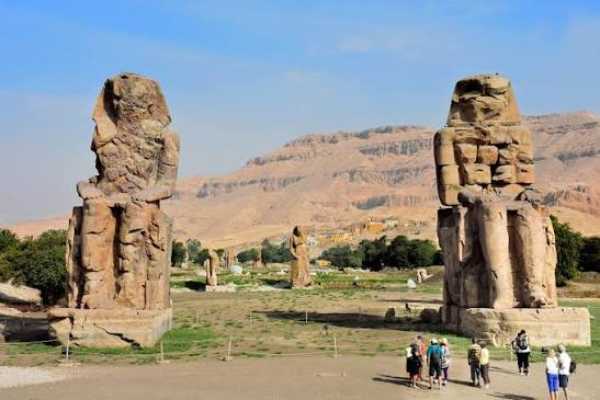
Each statue depicts a seated Amenhotep 3rd, pharaoh of Egypt from 1391 to 1353 BC.
One of the Colossi— after being damaged by an earthquake in the first century BC— was known for giving off an eerie whistling sound at dawn, as the stone contracted and expanded with the cold of night and heat of day.
The fifth of five statue bases standing in a north–south row within the boundaries of where the mortuary temple once stood, are important for our story.
The temple was located on the west bank of the Nile, near what is now known as the Valley of the Kings, across from the modern city of Luxor. The five bases each held a larger-than-life-sized statue of the king, although they were not nearly as tall as the Colossi placed at the entrance to the temple.
The court in which they stood contained almost forty such statues and bases in all.
The Aegean List Of Amenhotep 3Rd
Each of the 5 bases, as well as many of the others, is inscribed with a series of topographical names carved into the stone within what the Egyptians called a “fortified oval”—an elongated oval carved standing upright, with a series of small protrusions all along its perimeter.
This was meant to depict a fortified city, complete with defensive towers (hence the protrusions).
Each fortified oval was placed on, or rather replaced, the lower body of a bound prisoner, portrayed with his arms behind his back and bound together at the elbow, sometimes with a rope tied around his neck attaching him to other prisoners in front of and behind him.
This was a traditional New Kingdom Egyptian method of representing foreign cities and countries; even if the Egyptians didn’t actually control these foreign places or were not even close to conquering them, they still wrote the names within such “fortified ovals” as an artistic and political convention, perhaps as symbolic domination.
These statue bases had a list of geographical names, as an “Aegean List”, showing the world known to during Amenhotep III’s time, in the early fourteenth century BC.
The list has names never before mentioned in Egyptian inscriptions.
They were the names of cities and places located to the west of Egypt—strange names, such as Mycenae, Nauplion, Knossos, Kydonia, and Kythera, written on the left front and left side of the base, and with two more names written separately on the right front side of the base, as if they were titles placed at the head of the list: Keftiu and Tanaja.
What was the meaning of this list and their names?
What modern tourists to the site now see (usually as they are passing by the ruins in an air-conditioned bus on their way to the nearby Valley of the Kings) are the statue bases, and the statues upon them, being reassembled once again, to stand beneath the sun-drenched skies for the first time in more than three thousand years.
In 1998, a multinational team led by Egyptologist Hourig Sourouzian reopened the excavations at Kom el-Hetan.
They have been excavating there every year since and have recovered the fragments of the destroyed Aegean List statue base, as well as those of its neighbors. They are now in the process of reconstructing and restoring them. The eight hundred pieces from the Aegean List alone took more than five years to piece together.2
Only two of the names were familiar:
- Keftiu or Crete
- Tanaja or mainland Greece
The two names ‘Amnisa and Kunusa look uncomfortably like Amniso(s) andKnossos, famous ancient settlements on the north coast of Crete.
-
Keftiu (Crete) and
-
Tanaja (mainland Greece)
-
Knossos and its port city of Amnisos
-
Phaistos and Kydonia, listed in an order that goes from east to west
All of these either had Minoan palaces or, in the case of Amnisos, functioned as a port for a nearby Minoan palace.
Next on the list comes the island of Kythera, positioned midway between Crete and mainland Greece, and then important Mycenaean sites and regions on mainland Greece, including Mycenae and its port city of Nauplion, the region of Messenia, and perhaps the city of Thebes in Boeotia. Last on the list are more names from Minoan Crete, this time in order from west to east and including Amnisos again.
The list looks suspiciously like an itinerary of a round-trip voyage from Egypt to the Aegean and back again.
According to the order of the names, the voyagers from Egypt went first to Crete, perhaps to visit the Minoan royalty and merchants with whom, by this point, the Egyptians had been familiar for almost a century.
They then continued, via Kythera, to mainland Greece to visit the Mycenaeans—the new power on the scene, who were taking over the trade routes to Egypt and the Near East from the Minoans about this time. And then they returned to Egypt via Crete as the fastest and most direct route, calling at Amnisos for water and food as one of the last stops on the homeward journey, just as they had made that port their first stop shortly after setting out.
The lists on the statue bases as a whole catalog the world known to the Egyptians of Amenhotep III’s time. Most of the names were already known from other documents and treaties; among these familiar names were the Hittites and the Kassites/Babylonians (about whom more below), as well as cities in Canaan. The Aegean place-names, however, were (and still are) exceptional and were carved in a particular order. Some were even specifically recarved, for the first three names were recut (to their present values) at some point before or while the list was on display.5
Some scholars believe that this list is merely propaganda, idle boasting by a pharaoh who had heard of faraway places and yearned to conquer them or wished to convince people that he had. Others believe that the list is not mendacious selfaggrandizement, but is based on factual knowledge and actual contacts in that long-ago time. This latter explanation seems more likely, for we know, from the numerous other depictions in tombs of nobles dating to the time of Hatshepsut and Thutmose III in the fifteenth century BC, that there were multiple contacts with the Aegean during that earlier time, including instances in which diplomatic ambassadors and/or merchants came to Egypt bearing gifts. It is probable that such contacts continued into the next century, during the reign of Amenhotep III. If so, we may have here the earliest written record of a round-trip voyage from Egypt to the Aegean, a voyage undertaken more than thirty-four centuries ago, a few decades before the boy king Tut ruled the eternal land.
The suggestion that we are looking at the documentation of an early fourteenth-century BC voyage from Egypt to the Aegean, rather than a record of Mycenaeans and Minoans coming to Egypt, seems plausible for the following fascinating reason. There are a number of objects with the cartouche (royal name) of either Amenhotep III or his wife Queen Tiyi carved upon them that have been found by archaeologists at six sites scattered around the Aegean area—on Crete, mainland Greece, and Rhodes. There is a correlation between the Aegean find-spots of these objects and the sites named on the Aegean List, for four of the six sites are included among the names carved on it.
Some of these inscribed objects are simply scarabs and small stamp seals, but one is a vase; all have the cartouche of either the pharaoh or his wife. Most important are the numerous fragments of double-sided plaques made of faience, a material halfway between pottery and glass, which were found at Mycenae, probably the leading city in fourteenth-century BC Greece. These fragments, of which there are at least twelve, come from a total of nine or more original plaques, each measuring about six to eight inches in length, about four inches wide, and less than an inch thick. All had Amenhotep III’s titles baked onto them in black paint, reading on both sides of each plaque, “the good god, Neb-Ma’at-Re, son of Re, Amenhotep, prince of Thebes, given life.”6
Egyptologists refer to these as foundation deposit plaques. They are normally found, at least in Egypt, placed in specific deposits under temples or, sometimes, statues of the king.7 They function much as time capsules do in our present culture, and as such deposits have done since the Early Bronze Age in Mesopotamia. Their presumed purpose was to ensure that the gods and future generations would know the identity and generosity of the donor/builder, and the date when the building, statue, or other construction was completed.
What makes these plaques at Mycenae unique is simply that— they are unique in the Aegean. Actually, they are exclusive to Mycenae, out of all the places in the entire ancient Mediterranean world, for such faience plaques with Amenhotep III’s name on them have never been found anywhere else outside of Egypt. The first fragments at Mycenae were found and published by Greek archaeologists back in the late 1800s and early 1900s, when they were thought to be made out of “porcelain,” and Amenhotep’s name was not yet clearly recognized or deciphered. More were discovered over the years, including some by the eminent British archaeologist Lord William Taylor within the Cult Center at Mycenae. The most recent fragment was discovered just a few years ago, discarded deep within a well at Mycenae, by UC Berkeley archaeologist Kim Shelton.
None of the fragments have been found in their original context at Mycenae. In other words, we have no idea how they were originally used at the site. But the mere fact that they are at Mycenae, and nowhere else in the world, indicates that there is probably a special relationship between this site and Egypt during the time of Amenhotep III, especially since it is at Mycenae that the vase of Amenhotep III was also found, as well as two scarabs of his wife Queen Tiyi. Considering that this region was on the fringes—the very periphery—of the known and civilized region with which Egypt was in contact during this period, the correlation of these objects with the names on the Aegean List suggests that something unusual in terms of international contact had probably taken place during Amenhotep III’s reign.
The imported Egyptian and Near Eastern objects found in the Aegean form an interesting pattern, perhaps related to the Aegean List. Minoan Crete apparently continued to be the principal destination within the Aegean of the trade routes from Egypt and the Near East during at least the early part of the fourteenth century BC. However, since objects from Egypt, Canaan, and Cyprus are found in approximately equal quantities on Crete, it may be that goods from Egypt were no longer the dominant cargo being carried by the merchants and traders sailing between Crete and the Eastern Mediterranean, as had been the case during the previous centuries. If Egyptian and Minoan envoys and traders dominated the routes to the Aegean during the earlier periods, they were now most likely either joined, or even replaced, by others from Canaan and Cyprus.
Leave a Comment
Thank you for your comment!
It will appear after review.