
Table of Contents
140. The principle of the motion of a Planet
Assume that the body N is less solid, or rather:
- has less force to continue its motion in a straight line than the air-aether at the edge of our solar system
- but more force than the air-aether near our Sun
As soon as it is carried by the air-aether of our solar system, it must continually go towards the center of our solar system until it reaches the orbit that matches the speed of its air-aether.
- This makes it into planet.
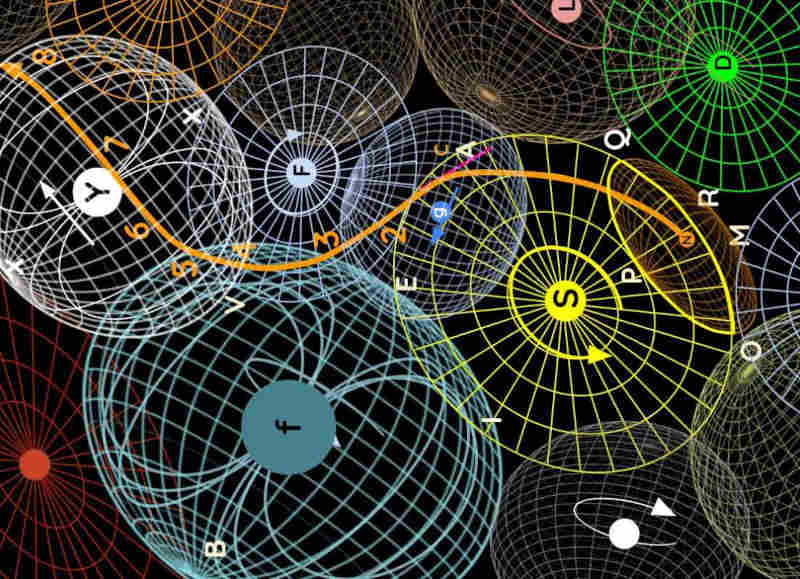
If it fell closer to the Sun, it would be surrounded by smaller air-aether [higher frequency 2nd Element].
- This would cause a mismatch that would cause it to go back out in orbit.
If went farther in orbit, it would encounter the 2nd Element that were larger and less agitated. This would reduce its motion causing it to go back closer to the sun.
If it were to approach the Sun more closely, it would move among slightly smaller air-aether globules there.
Therefore those which it overcomes with force to move away from the center around which it revolves; and being moved faster.
Therefore the force would increase with its agitation causing it to regress from there again.
141. Causes on which its errors depend
Other causes which somewhat propel the Planet around the Sun here and there are:
- The space where it rotates with all the air-aether is not perfectly spherical.
Where this space is wider, the air-aether must flow more slowly than where it is narrower.
142. 2nd Cause
- The fire-aether flows from some neighboring vortices towards the center of the current Vortex.
From there, it flows back to the other vortices. It can move both the air-aether globules and also the Planet balanced among them in various ways.
143. Third.
- The passages within the body of this Planet might be more suitable for receiving the striated particles and the other fire-aether particles coming from certain parts of outer space, than for receiving others.
The openings of these passages form around the poles of the spots of the stars. These are turned towards those parts of outer space rather than towards others.
144. Fourth
- The planet might already have some motions which persist in it for a very long time even if other causes oppose them.
A whirlwind might acquire sufficient force to continue its motion for a few minutes. Even if its mass is small, it might complete several thousand revolutions while it is opposed by:
- the surrounding air and
- the earth on which it stands
Similarly, a Planet’s intial motion when it was first made from the beginning of its galaxy can continue up to this time without any notable decrease in speed.
145. Fifth
The force of persevering in its motion is much stronger and more constant in a Planet than in the air-aether surrounding it.
This force is even stronger in a large Planet than in a small one.
This force in the air-aether is from all its globules conspiring to the same motion.
Since they are mutually separated, their conspiring can become less or more sometimes.
This is why a Planet never moves as fast as the air-aether globules surrounding it. It equals their motion that carries it with them. Yet, they have more motion since they are mutually separated.
It follows that when the motion of these air-aether globules is accelerated, slowed, or deflected, the motion of the Planet revolving among them is not so much accelerated, slowed, or deflected.
Leave a Comment
Thank you for your comment!
It will appear after review.