
Table of Contents
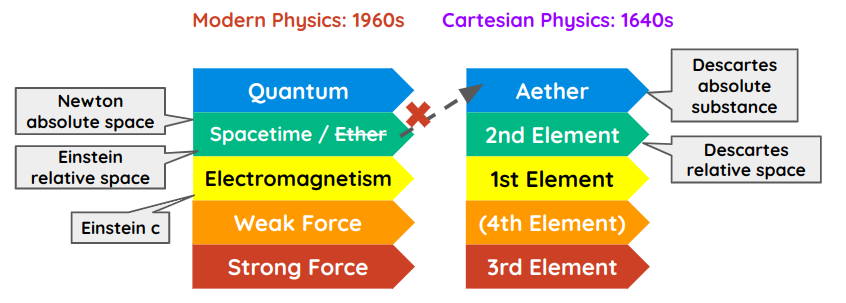
Before Newtonian Physics was created, the mainstream Physics was from Descartes who used a 5 Element paradigm which was derived from the Physics of Aristotle and Timaeus. This was consistent with the 5 Elements model of Hinduism and Taoism.
This model had 5 Elements, 3 of which are known by Physics as the Standard Model
| Element | Physics Equivalent |
|---|---|
| Aether | Pseudo science |
| Air | Spacetime |
| Fire | Electromagnetism |
| Water | Weak Force |
| Earth or Matter | Strong Force |
The Subjectivity of the Aether
The aether model is confusing for materialists because they believe that matter is the supreme Element.
- Extreme materialists like Einstein regard the aether as insignificant.
In reality, the aether is supreme, and matter is insignificant, since physicality is an illusion.
We define the aether as the substance of ideas, feelings, and the abstract minds that have those ideas and feelings.
This is why the aether is the core ingredient in quantum mechanics which creates superposition and decoherence – the observing mind is part of the system being tested!
This is why quantum mechanics is spooky to materialist physicists who see matter as the highest Element, when in fact it is the lowest and crudest.
The aether serves as the foundation of the abstract sciences such as psychology, politics, economics, sociology, just as matter and energy serve the foundation of Physics and Engineering.
The life sciences such as biology, medicine, and agriculture are in between both.
Einstein Debunking the Aether
Materialists hate subjectivity so much that they do everything that they can to discredit the subjective aether that is the basis of the subjective universe. This is exactly what Einstein did when he interpreted the Michelson-Morley experiment in favor of electromagnetism, while denouncing the abstract mind (soul, feelings).
These two postulates of Relativity suffice for a simple and consistent theory of the electrodynamics of moving bodies based on Maxwell’s theory for stationary bodies. The introduction of a “luminiferous ether” is superfluous. There is no need for an “absolutely stationary space” that has special properties.
Einstein created Relativity by simply ignoring the aether that would later facilitate quantum mechanics. This is why he was against quantum mechanics in his paper “Is the Quantum—Mechanical Reality Complete?”.
The consistent success of quantum mechanics and the consistent failure of theories derived from General Relativity such as String Theory, Loop Quantum Gravity, Supersymmetry, Big Bang, Wormholes, White Holes, etc show that Nature is quantum mechanical, and not Einstein-Relativistic.
Physicists stupidly think that Einstein successfully debunked the aether, when he wrote:
There is no such thing as a “specially favoured” (unique) coordinate system that allows the æther-idea. Hence, there can be no æther-drift nor any experiment with which to demonstrate it.
But since the aether is really the supreme Element, then all he really did was stop the progress of Physics.
The Huygens Ether, Frensel Ether, and Descartes Aether are Different
Einstein’s statement shows the confusion of physicists on the aether idea.
| Aether | Superphysics Equivalent |
|---|---|
| Descartes | Aether |
| Huygens and Leibniz | Pure Spacetime via Light |
| Fresnel | Spacetime in Material Layer via Light |
| Stokes | Spacetime in Material Layer via Matter |
| Maxwell | Spacetime in Radiant Layer via Light |
| Helmholtz and Kelvin | Aetherspace in Material Layer via Heat |
As you can see, there were many aether ideas which is really just a representative idea or variable to something invisible that causes an real phenomenon.
Let there be assumed at the beginning a Solar Globe, a Terrestrial Globe, and an intermediate space which is at rest. This space we shall call aether.
The modern luminiferous aether theory is from Fresnel who described light moving in a crystal, making it variant and directional.
The intensity of light is proportional to the square of the speeds of the particles. The intensity of vibration, on the other hand, is the speed of an ether particle during its oscillation.
However, the Michelson-Morley experiment proved that the light was invariant. Therefore, it debunked the variant Fresnel ether.
Invariance as Proof of the Subjectivity of the Universe
To Descartes, light is invariant because light’s job is to relay information about the light source which in turn is a spatial vortex.
Light is the carrier of the lively action which passes towards our eyes from a luminous body

This invariance shows the independence of spatial vortices (2nd Element) from each other, something that matter (3rd Element) does not have.
Fresnel’s aether is based on matter and so it is variant. This applies to light within glass or crystals and is the mechanism for our proposed optical computing.
Unlike rotating matter, a spatial vortex spins through time in independent moments. This makes it subjective or invariant.
Physicists then used this invariance to create failed gauge theories:
The Problem Began with Huygens, Made Worse by Fresnel
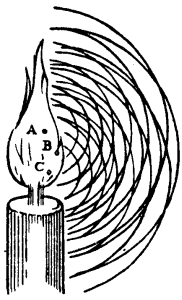
The whole confusion with the aether and space began when Huygens wrongly renamed the pure 2nd Element as Ethereal matter. This mixed it up with the pure aether as the 5th Element.
The movement of light coming from the luminous body is propagated through what I call “Ethereal matter”. It is not the same that serves for the propagation of sound.

Superphysics Note!
The original name of Descartes for space media or space particles is “subtle air” as the 2nd Element which we can equate to “virtual air” as opposed to physical (material) air which is really the 3rd Element or matter.
- This is consistent with Timeaus’ virtual air, Hindu virtual air or vayu, and Chinese virtual air as chi.
The aether name is reserved for the 5th Element which is called aether by Timaeus, akasha by Hindus, and water by Taoists.
Space-Time is Not Material
The final error of Physics is to think that the either the aether or the 2nd Element are material in nature.
In reality, they are metaphysical because they are above electromagnetism (1st Element). They can only be detected by the aethereal mind which is made of the same substance:
- the mind can detect all 5 Elements
- instruments can only detect 3 Elements
This makes Physics perpetually impotent in discovering the full properties of Nature. This is why our proposed Superphysics has both physics and metaphysics combined.
This will allow us to discover their properties in order to develop technologies that defy space and time, such as levitation, teleportation, and time travel.
Our Naming Solution: Crude verus Subtle Aether
Since the aether name has been thrown around by physicists from Hugyens to Leibniz to Fresnel to Einstein, it would be futle to rename it as “virtual air” which is its traditional name.
Instead, we stick with the aether name, but add a qualifier as it being the crude aether, as opposed to the pure aether as the 5th Element.
- The crude aether is the stuff of empty space which leads to vacuum energy, black holes, dark matter
- The pure aether is the stuff of the soul or abstrct mind that perceives empty space and the stuff in empty space.
For example, the abstract mind creats a perception of a material ball (3rd Element) floating in outerspace (2nd Element) because of the light (1st Element) bouncing off of the ball that is seen by the eye and recreated in the abstract mind (5th Element).
Leave a Comment
Thank you for your comment!
It will appear after review.